 Credit: Rick Osentoski-Imagn Images
Lost in translation: Michkov, Flyers still searching for common language
VOORHEES, N.J. — If there was any doubt about the Flyers’ commitment to Matvei Michkov, it was there in spades on Tuesday.
There sat each of the team’s leaders, each coming to the defense of the 21-year-old winger. You’ll likely hear more carefully-crafted responses from coach Rick Tocchet on Wednesday and General Manager Danny Briere on Thursday.
They know what Michkov means to the fanbase. They know what he means to the organization and the ongoing rebuild. Heck, Michkov knows, too. And while some of the answers he gave during his session with the media on Tuesday left a lot to be desired, there were those that also indicated that he, too, recognizes his place in the Philly sports landscape and that he needs to be better at securing his space within it.
Why, then, does it just feel like there is still some disconnect that may be really hard for both Michkov and the Flyers to traverse?
Why, then, does it feel like even though there seems to be an honest commitment to one another, that there remains a cloud of uncertainty about it?
Part of that is on the Flyers with how they portray things publicly or how they let nonsensical narratives run rampant.
Part of that is on Michkov needing to buy into what the team is selling as far as their plan for his development.
And part of it are the normal growing pains that come with player development.
“It’s difficult because I remember when I was his age trying to find my way, it’s not easy,” said Travis Konecny. “He’s a guy that’s always putting in the work. He’s always in the shooting room. He’s always on the ice doing extra stuff. So, you know, that part of it is there. It’s just trying to find where he’s comfortable, whether it’s at dinner, or wherever it is, to help him get to that next step.
“It takes time for some guys. I couldn’t imagine going over there and trying to understand Russian for two years. I’d be pretty lost at times, too. But when he’s doing the good things, when he’s scoring goals and making good plays, you just make sure you are there to pat him on the back. Hey, this is the good stuff. This is the stuff that if you do it over and over again you’d be a heck of a player.”
The last part of it, though, is the part that, prior to a decade ago, didn’t really exist. And that’s the absolutism that exists online.
In other words, the instant outrage. The overblown — and sometimes intentionally so — reactions that are exacerbated and catch on like wildfire.
They can’t be controlled. Fans are going to fan. Even if they aren’t real fans and are individuals simply looking for attention on a specific online platform, it has an impact. Because, of course, a young player trying to make his way in the best league in the world is going to see it. The team can talk all it wants about ignoring the noise, but he’s not going to be able to miss it.
He’s going to get questioned about it by family, friends, and in Michkov’s case, where things are equally heightened because he’s from another country, a whole second batch of media is taking this outrage to heart and using it to fuel their own stories from afar.
So, even though that voice is a minority one, its volume matters more in this instance because it’s wreaking havoc back home for Michkov, too.
It’s because of that that it’s easy to feel sorry for him on a certain level. Here’s a young man, trying to make his way in an new country, with a communication barrier because his command of the language spoken by the majority isn’t the greatest, trying to perform under intense public scrutiny and with the weight of such heavy expectations.
Add in the fact that his rock for the first 18 years of his life, his father, died under mysterious circumstances just before he was drafted three years ago, and it’s easy to want to give Michkov some grace.
Keep in mind, too, that he wasn’t even supposed to be here, yet.
When the Flyers drafted him in 2023, it was a known fact that he had a three-year contract with SKA St. Petersburg in the KHL in Russia. that was alleged to be incredibly difficult to get out of, meaning he wasn’t expected to even show up in the NHL until 2026-27. The Flyers drafted him with that knowledge. They were in the middle of a rebuild, anyway. They could have the patience to wait.
However, circumstances changed. Behind the scenes, the Flyers worked with Michkov’s agents to get him out of that deal and over here two seasons early. His arrival, while it didn’t change the timeline of the planned rebuild, changed the course of how the Flyers would approach it.
And his rookie year was a good one. He led all rookies in goals. He finished fourth in the Calder Trophy voting for NHL rookie of the year. There were clear signs of the promise Michkov brought with him as a highly-skilled, and dangerous, scoring winger.
But it wasn’t all sunshine and rainbows.
Then-coach John Tortorella clashed with Michkov. He benched him for periods, or longer. He scratched him from games. At times, it seemed a little gratuitous. It seemed more “my way, or else.” But on a team going nowhere and with a rookie player who everyone understood needed to adapt his game to the NHL, while some were miffed, it was accepted as part of his development.
Then the offseason happened. Michkov didn’t prepare properly. He came to training camp completely out of shape. That’s a cardinal sin in hockey because it’s impossible to catch up in a sport where in-season training is far different than off-season training.
It became a point of contention for many. There were those disappointed in Michkov and there were those furious at new Flyers coach Rick Tocchet for bringing it to light and repeating it, repeatedly.
Michkov finally opened up about it and admitted that he didn’t train properly and that he would learn from it and be better next offseason.
It was clear that was impacting his game. He couldn’t keep up. He was noticeably frustrated. He vowed to improve over the Olympic break.
He did.
When he came back from the break, he looked rejuvenated. He looked better. He started putting up points, which was a step in the right direction, even if there were parts of his game that were still well behind.
It was going smoothly, until Tocchet chose to criticize him again, publicly, at the Flyers Charities Carnival.
What Tocchet said wasn’t wrong, but how the message was delivered was off base. It didn’t help that there was no way for Michkov to also offer his side. The Flyers lack a true interpreter. They use skating coach Slava Kuznetsov to translate for Michkov. Kuznetsov does yeoman’s work, but it’s not his best skill set.
That is training ice skaters. In fact, Michkov couldn’t speak to the media for about six weeks while Kuznetsov was away at the Olympics working with U.S. figure skater Isabeau Levito, whom he trains in South Jersey.
It sent things into a spiral. The Flyers were seemingly going nowhere in early March. The online accusations of mismanagement of another young star player were five-alarm fires, as many were still feeling the sting of the whole Cutter Gauthier situation. Flyers G.M. Danny Briere had to hold an impromptu press conference in the press box before a game to try to quell the masses.
There are no doubts that the Flyers have boggled the public facing aspect of this whole thing. Even though they have gone to great lengths to give Michkov everything he needs to succeed – such as bringing his mom and brother over to New Jersey, and providing him with a trusted confidante in Kuznetsov and hiring former Russian player Oleg Znarok to be a scouting consultant, so Michkov had another familiar face in his Philadelphia orbit. Still, their management of Michkov publicly has not been ideal, which is mind-boggling, especially since their behind the scenes handling of him was 100 percent doing what is in both the best interest of the player and the organization.
As the team was making a hard push for the playoffs, the Michkov dilemma took a backseat. He was playing well enough, and the team was winning. The focus started to shift. With the exception of some online sycophants, the focus was no longer on whether or not the Flyers were mismanaging Michkov, but rather, are the Flyers really making a miraculous run to the playoffs?
The rest was history.
Michkov was a sizable part of that run, but in the playoffs, the game ramped up another level. He was clearly outmatched. Although he had worked hard enough to get back to being a contributor at the end of the regular season, and was able to score 20 goals and register a respectable 51 points, he wasn’t ready for the pace and physicality of postseason hockey. It’s a different game. A different season. A different style.
He played in eight of the Flyers’ 10 playoff games. He registered just one assist. And if Michkov isn’t producing, his spot in the lineup is tenuous in the playoffs, because there needs to be an equal commitment to doing other little things well if you aren’t scoring. He wasn’t doing those either.
When he was scratched in Game 5 against Pittsburgh, it seemed like a pure coaching decision. He came back, had a decent Game 6, but then looked under water again at the start of the Carolina series. So, when he was scratched again in Game 4 against the Hurricanes, it seemed more like a complete organizational decision.
Michkov has a lot of work to do to avoid that in the future.
That brought us to Tuesday.
Finally afforded an opportunity to talk to Michkov, the media started asking questions. And the first one was a gimme. A softball. How would Michkov assess his own season?
He seemed uncomfortable. As if he didn’t want to answer. He shifted in his seat. He quickly displayed a nervous grin, one that is often equated to disbelief — as if this shouldn’t have been the first question, in his mind. And after a few seconds, he decided the best answer was, “no comment.”
Off and running.
When asked if he was given a reason for being benched against the Hurricanes, he gave a response.
“It was a coach’s decision,” he said through Kuznetsov’s interpretation. “I’m a player that should go on the ice and do my job. If the coach decides I have to miss the game, I have to take it. I have to go back on the ice and train and work for the best. Unfortunately we cannot control what we can’t control.”
Fair response.
He would later go on to offer some self-criticism on his play in the playoffs.
“I was trying to help on the defense and trying to do what the coach told me to do,” he said. “(But) it was the first playoff for me and I cannot say it was easy for my game in the playoffs. I’m a player that the team expects to score and make plays, but the fact is, at the end it was eight games and one assist. …
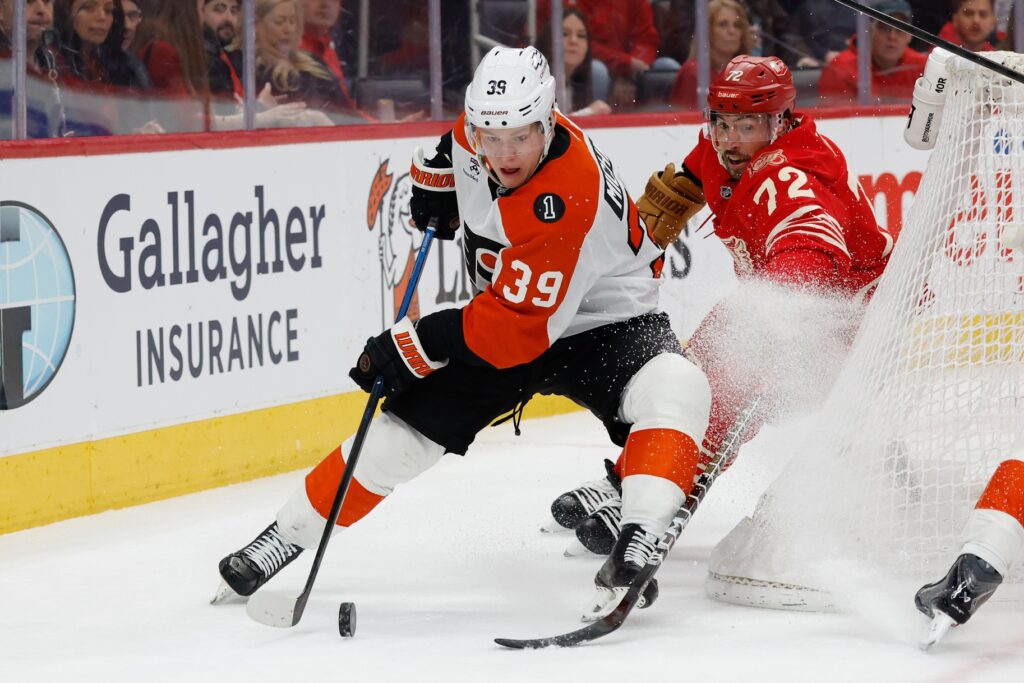
“It was an unreal atmosphere. A lot of kids were wearing my number 39. I’m a little bit ashamed that I couldn’t score for them in the playoffs.”
That’s a good sentiment, although, one would hope that he gets the message that went into the two scratches in the playoffs and understands why he was benched. That part is still an unknown.
Asked if he understands what the team expects from him going forward into the summer to be able to take the next step in development and be a better player, he asked if he could skip the question.
A follow up question asking him what he specifically wants to work on this summer didn’t offer much more insight.
“I’m not sure what to answer you on that question,” he said. “I will work. We’ll work on it. I’ll just put the work in. Do you think I was not ready after the Olympic break, in your opinion? Next year I plan to be even better (than I was) after the Olympic break.”
Well, that last part’s a positive. He feels like he has something to prove. That has to be a good sign, right?
Except, he dodged another question asking if he was still planning to train here this summer, as he said he would back in February, rather than return to Russia.
“I’m just planning to work,” he said. “After the press conference and I’m going back on the ice and start working as of right now.”
Stay tuned on that one.
Then he was asked about his relationship with Tocchet. This was his most important answer.
“It’s a very simple working relationship,” he said. “It’s a good relationship.”
While it might not be the most glowing praise, he also didn’t say it was a challenge. He described it as good. Which Tocchet has also said previously. That at least has to relieve some of the narrative pressure, no?
Who knows?
A lot of the issues here seems to be lost in translation, and that’s unfortunate.
“I think he’s starting to … I wouldn’t say he’s comfortable yet, but he’s speaking better English,” said captain Sean Couturier. “I think he’s communicating a little bit better. But he’s still young. He still has huge potential, huge upside in his game. And I can’t imagine the language barrier at a young age and coming overseas. You know, it took me, personally, a couple of years to figure everything out and put everything together.
“It’s only his second year in the league and I’m sure he’s going to learn from this past year. Knowing him, knowing his character, I’m sure he’s going to be super motivated to kind of prove everyone wrong next year, and that’s what you want to see.”
Noah Cates, who was Michkov’s center for most of the year, even suggested that working with Michkov is a little more challenging because of the language barrier.
“Coming out of the Olympic break, just his skill set and how hard he was on pucks when he was skating, he was ready to go,” Cates said. “We were clicking and playing well and helping the team. In the playoffs it’s a different game. … (Because of) the pace and stuff, we weren’t on the same page, or whatever it might have been. …
“The communication might be a little slower. You might need a (dry erase) board or something like that. There were a couple times where he wanted to do some video int he hotel or whatnot. That might take an hour or whatever. … So, yeah, it’s a little more time consuming, but we’re at the rink six hours a day, so it’s not that big of a deal. … I guess we’re maybe a little slower, maybe a little more methodical with communicating.”
That’s why Michkov’s offseason work isn’t just so much about making sure he comes into camp in shape next season. Sure, that’s going to be what everyone talks about after this past season, but he’ll need to progress in other areas as well. He’ll need to work on parts of his game that he didn’t want to discuss in specifics with the media. What parts? That will be relayed to him on Thursday when he meets with Briere, Tocchet and President Keith Jones to discuss the offseason plan.
But it would go a long way if the Flyers and Michkov could also develop a better communication plan as well. This isn’t a demand for Michkov to become more fluent in English. Would it help? Sure. But it is a hard language to learn. In the interim, the Flyers should be eager to help him find other ways to get the communication part improved.
Michkov also has to work on improving his fit into the locker room dynamic. It’s a tight locker room. A close knit group. With the exception of Michkov, they all saw their games improve with the coaching staff from where it was previously and a lot of guys attributed that to the buy-in of the team feeling comfortable enough to hold each other accountable because of their brotherhood. He has to figure out how to be a part of that more.
But make no mistake about it, the Flyers still want Michkov to succeed and be a big part of their future. With a few public-facing hiccups aside, the organization has handled the situation internally with him about as best as it possibly could. They just need the player to buy into what they are preaching and building from a team dynamic.
If there was a second silver lining in the answers Michkov gave at his presser, it might be just that he remains committed to the organization, isn’t looking to get out but rather wants to win here and is determined to prove his doubters wrong.
“Next season we want to go more than just the second round,” he said. “This season we tasted the playoffs and it was really good. Next season we need to go even further and the progress will show. And every player has to work even harder to make that happen so it becomes true.”
The work, for everyone involved, starts now.