
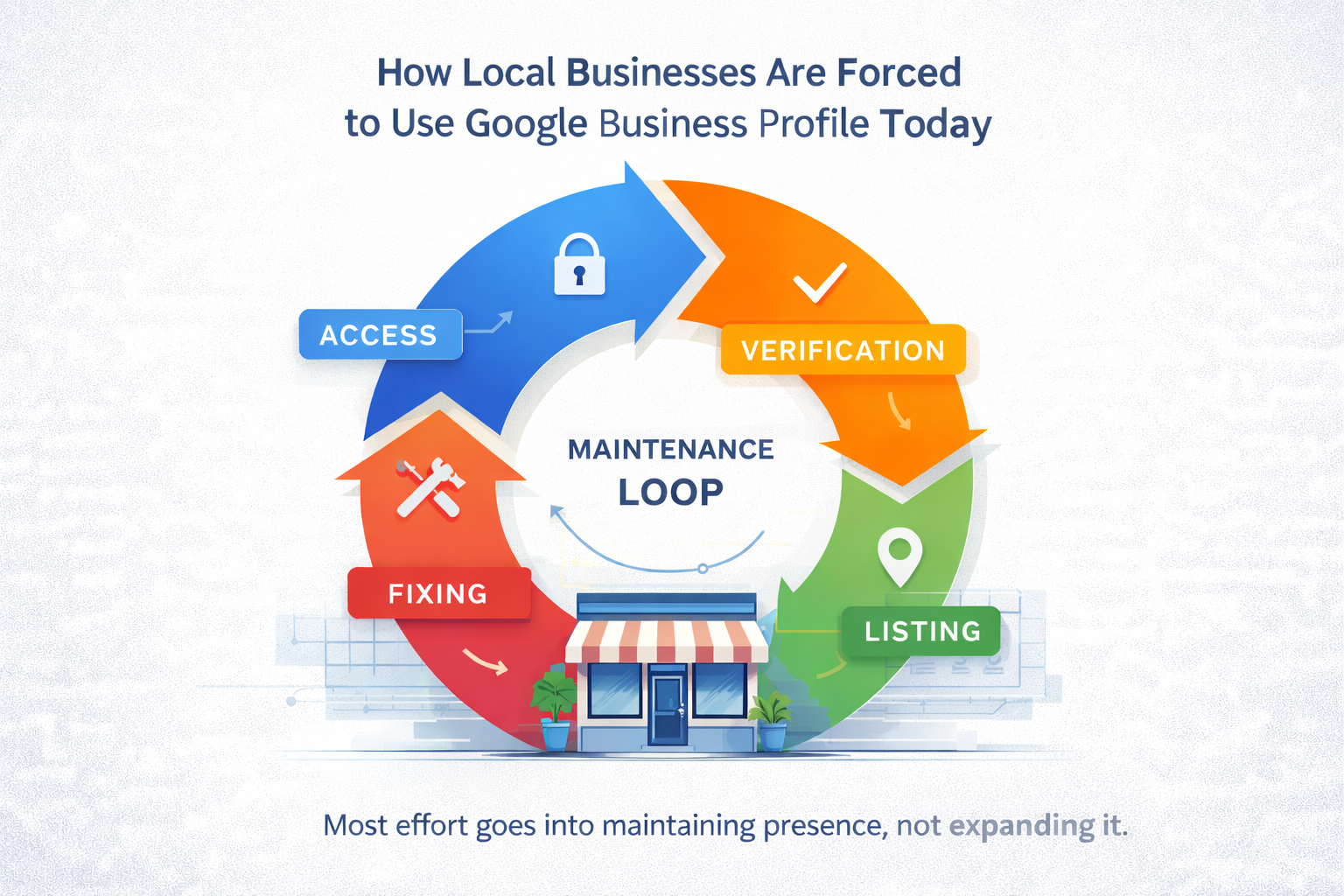
Search behavior around Google Business Profile shows local businesses are no longer focused on optimization or growth. Instead, they are searching for ways to maintain access and continuity when something goes wrong.
According to research conducted by KeywordProbe, an SEO agency that analyzes real-world search behavior across local markets, the highest-demand queries tied to Google Business Profile now center on basic operational needs, including:
● Regaining account access
● Completing or fixing verification
● Claiming business ownership
● Diagnosing sudden visibility loss
● Appealing profile suspensions
“This isn’t how a growth channel behaves,” said Fahad Raza, founder of KeywordProbe. “When businesses spend more time trying to log in, verify, or recover listings than improving visibility, it tells you the platform is being used defensively, not strategically.”
Raza said the shift reflects how local businesses now experience Google Business Profile in practice, not as a marketing tool, but as critical infrastructure that can interrupt operations without warning.
“Most owners aren’t asking how to beat competitors anymore,” he said. “They’re asking how to stay visible at all. That change shows up very clearly in search queries, long before it shows up in revenue reports or surveys.”
Raza added that this pattern has become more pronounced over the past year as automation, verification changes, and platform updates have increased uncertainty.
“When visibility depends on a system you don’t fully control, behavior changes,” he said. “Businesses start thinking less about optimization and more about continuity. Search data is simply reflecting that reality.”
From growth channel to operational burden
What the search data shows is not panic, but reallocation of effort.
That shift is visible in how businesses search. Instead of exploring ways to improve rankings or outperform competitors, they are spending time diagnosing access issues, resolving verification problems, and recovering from sudden visibility loss.
This behavior suggests that a significant portion of local search effort is now reactive, not strategic.
Source: SEMrush keyword data (US).
Methodology: Volumes aggregated across semantically related Google Business Profile queries expressing the same operational intent.
Analysis period: January 2026.
Access management and verification alone account for the largest share of search demand. Tasks traditionally considered “one-time setup” have become recurring maintenance work. Visibility loss and suspension recovery, while smaller in volume, still register at meaningful scale—suggesting these are not rare edge cases.
Taken together, the data shows that growth-oriented activities are being crowded out by maintenance tasks.
When infrastructure becomes unpredictable, behavior changes.
Historically, local SEO rewarded proactive effort. Businesses that invested time in optimization generally saw incremental gains.
Today, many businesses are behaving less like marketers and more like risk managers.
Rather than asking how to outperform competitors, they are asking how to avoid downtime, retain control, and preserve discoverability when systems fail. This shift explains why so much demand clusters around access, verification, and recovery rather than growth tactics.
When a platform shifts from a perceived opportunity to a potential point of failure, businesses adapt by reducing reliance on any single system.
Rather than chasing new optimizations, many focus on reinforcing the fundamentals, ensuring their business information is consistently validated across the wider local web. In this context, a local business citation service is used less as a rankings tactic and more as a structured way to manage name, address, and entity consistency at scale, helping ensure a business remains discoverable and correctly represented even when a primary platform becomes unstable.
Google Business Profile has become essential to local visibility, yet control over that visibility feels increasingly limited.
Verification methods evolve. Automated enforcement scales rapidly. Appeals remain opaque. Support responses are often delayed or generic. Meanwhile, a single disruption can remove a business from Maps, local results, and mobile discovery almost instantly.
This creates a paradox. The more central Google Business Profile becomes, the less predictable it feels to the businesses that rely on it most.
In other marketing channels, instability typically leads to diversification. Local search is no different. Businesses are not abandoning Google, but they are no longer treating it as the sole source of truth.
Several forces are converging to drive this change in behavior:
● Automation at scale
Enforcement and verification systems increasingly rely on automated decision-making, reducing nuance for legitimate edge cases.
● Ongoing product experimentation
Changes to reviews, Q&A, and verification workflows introduce uncertainty that businesses must constantly adapt to.
● AI-mediated discovery
As AI-driven results compress visibility into fewer answers, data accuracy and consistency become more critical—and more fragile.
● Persistent terminology confusion
Many businesses still operate under outdated mental models of the platform, increasing the likelihood of errors and mismanagement.
Together, these factors push businesses toward defensive decision-making.
What’s emerging is not the decline of local SEO, but its evolution.
Local SEO is increasingly about continuity planning—protecting access, ensuring consistent entity signals, and minimizing the impact of platform volatility. Foundational elements such as accurate business data, consistent citations, and corroboration across trusted directories now function as safeguards, not growth hacks.
This explains why citation and directory-related searches remain steady even as interest in promotional tactics fluctuates. Durability is taking precedence over experimentation.
This trend extends beyond SEO. It reflects how small and local businesses perceive platform risk more broadly.
When search behavior shifts from “How do I grow?” to “Why can’t I access my listing?”, it signals declining confidence. Platforms rarely lose relevance overnight. They lose trust gradually—through friction, unpredictability, and a lack of transparency.
Search queries often surface that loss of confidence before it appears elsewhere.
Google Business Profile remains indispensable for local discovery. But it is no longer experienced as a stable, growth-first channel.
Search data makes this clear. Local businesses are spending more effort maintaining access and recovering visibility than optimizing for competitive advantage.
That shift marks a new phase in local search—one where resilience, consistency, and risk reduction matter as much as rankings. The businesses that endure will not be the ones chasing every update, but those building visibility systems designed to withstand disruption when a single platform falters.

