
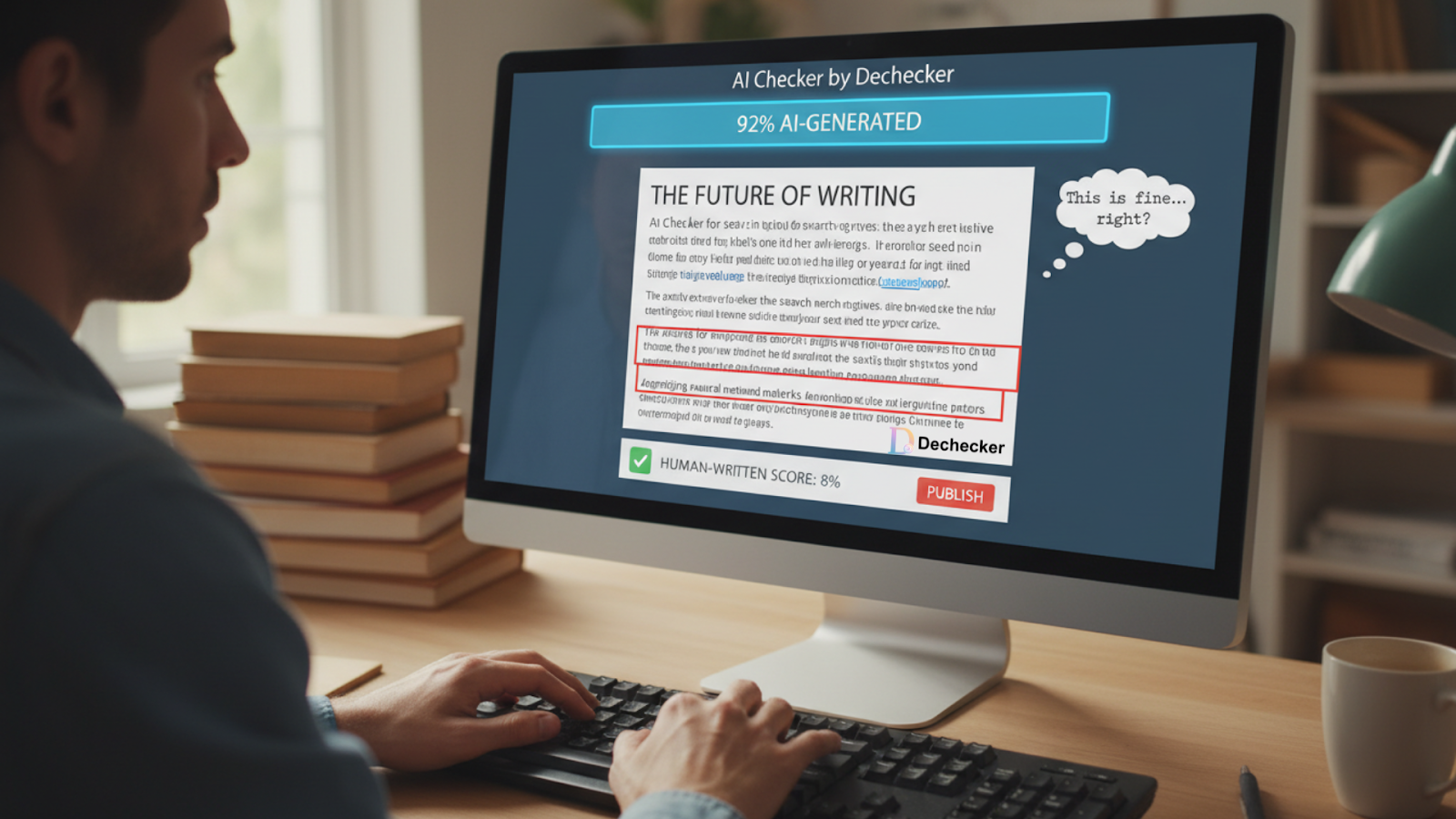
There’s a moment right before you publish something when doubt kicks in. You reread the intro. You skim the middle. You glance at the ending and think, “This is fine… right?” For a long time, that’s where I stopped. Now, before anything goes live, I run it through AI Checker by Dechecker. Not because I don’t trust myself, but because I’ve learned how easy it is for writing to slowly drift into something that doesn’t feel human anymore.
Most people don’t wake up one day and decide to publish AI-written content. It usually starts with a paragraph suggestion. Then a rewritten sentence. Then a cleaned-up conclusion. Over time, your drafts get smoother, faster—and strangely interchangeable. I’ve looked back at old articles and realized I could’ve swapped the author name with anyone else’s. That’s when I knew something was off.
AI Checker helps catch that drift early. It shows me where the text stops sounding like a person thinking and starts sounding like a system completing a task.
AI is great at structure. Introductions land cleanly. Arguments line up. Conclusions wrap things up nicely. But humans don’t always write like that. We circle ideas. We pause. We change our minds mid-paragraph. When everything is too tidy, readers sense it—even if they can’t explain why. AI Checker doesn’t punish polish, but it highlights when polish starts replacing personality.
I don’t treat Dechecker as an authority. I treat it like a mirror. When it flags a section, I don’t automatically rewrite it. I reread it and ask myself, “Would I really say this this way?” If the answer is no, I change it. If yes, I leave it. That simple pause has improved my editing more than any style guide ever did.
One mistake I made early on was only checking finished pieces. Now I run drafts through AI Checker earlier, when they’re still rough. That’s when it’s easiest to fix tone issues. A small tweak early saves a full rewrite later. It’s especially useful for long-form content, where patterns sneak in without you noticing.
Opinion-based writing suffers the most from AI overuse. The moment a strong opinion starts sounding neutral, it loses power. I use AI Checker to protect that edge. If a paragraph reads like it’s trying to please everyone, that’s usually a sign it needs rewriting. Readers don’t want perfect balance. They want honesty.
Even internal content matters more than people think. Strategy docs, onboarding guides, internal posts—if they feel robotic, people disengage. I’ve started checking internal writing too, especially when it’s been “cleaned up” by AI. The difference in how teams respond is noticeable.
For projects involving interviews or recorded calls, I’ll usually transcribe everything with an audio to text converter first. Transcripts are efficient, but editing them with AI can quickly strip out personality. Running the final version through AI Checker helps me keep the original voice intact.
After a few weeks, you begin spotting AI patterns without the tool. Over-explained transitions. Sentences that sound impressive but say very little. Paragraphs that feel like filler. AI Checker trains your ear in a quiet way. It doesn’t tell you how to write—it shows you where you stopped sounding like yourself.
One unexpected benefit is confidence. Before, I’d second-guess everything. Now I know which parts are worth fixing and which parts are fine. Not every flagged sentence needs changing. That permission to not over-edit is important. Real writing isn’t perfect, and that’s the point.
Some tools try to scare you with big percentages or bold warnings. Dechecker doesn’t do that. It gives clear signals and lets you decide what to do. That respect for the writer matters. Especially if you’re working on nuanced or creative content, where rigid rules don’t apply.
I wouldn’t use any tool that slowed me down. AI Checker is fast enough that it doesn’t break concentration. Paste, scan, adjust, move on. That’s why it stuck. It feels like part of editing, not a separate process.
There’s no point pretending otherwise. AI writing will get more convincing. That’s exactly why detection tools need to evolve quietly in the background. Dechecker doesn’t feel reactive or outdated. It feels current, which is more than I can say for most tools in this space.
At the end of the day, tools don’t replace judgment. They support it. AI Checker doesn’t tell me what to think or how to sound. It just helps me notice when I’ve stopped thinking on the page. That awareness is what keeps writing human.
I don’t use Dechecker AI Checker to avoid AI. I use it to stay present in my own work. It’s a small step in the publishing process, but it has a big impact on how my writing feels—and how readers respond to it. For anyone who writes regularly and actually cares about voice, that difference matters.

