
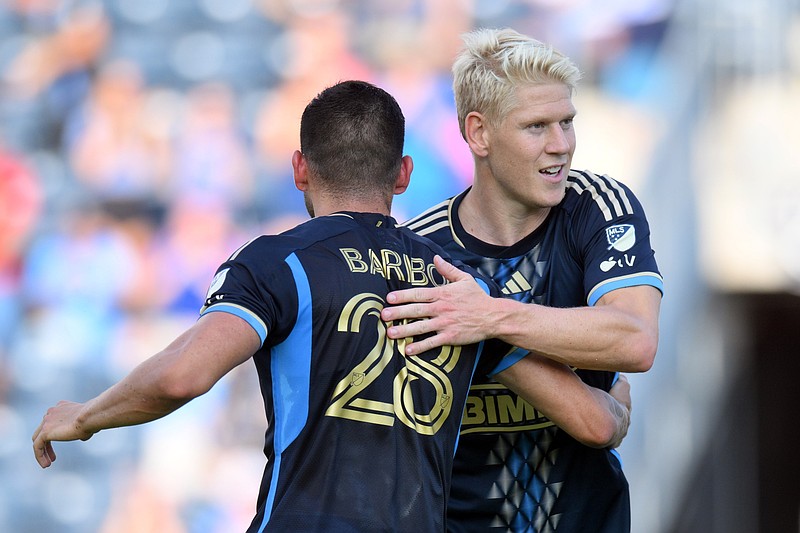
Philadelphia Union forward Tai Baribo, left, celebrates with defender Jakob Glesnes after scoring a goal against the Colorado Rapids during a Leagues Cup match on Aug. 25, 2024 at Subaru Park. Mandatory Credit: John Jones-USA TODAY Sports
In a world outside of soccer, trading two players that were all-stars in a season where you had success but fell short of a championship would seem … perplexing.
In the world of soccer at outposts that aren’t Chester, it might still seem a quandary.
But business for the Philadelphia Union – proudly, defiantly – isn’t conducted as elsewhere in MLS. And thus the plausible spin emanating this week from Chester upon Jakob Glesnes and Tai Baribo departing in intra-league trades is, predictably, about keeping the team competitive in the long-term.
It wouldn’t be the first time a transaction looked unpopular in the moment but ultimately proved fruitful. Recall that last year’s moves to trade Daniel Gazdag and Jack McGlynn in league were deeply unpopular. Gazdag struggled in Columbus. McGlynn’s Houston Dynamo failed to make the postseason. The Union won the Supporters’ Shield.
But moving Glesnes and Baribo to teams elsewhere in MLS offers another glimpse at the constraints on the Union’s ambition – for a team that still doesn’t have an MLS championship and in this week’s business moved no closer to that point.
In isolation, the moves make sense. Glesnes is signed through 2027 with an option year for 2028. He’ll turn 32 in March. He was great in 2023, awful in 2024 and great again in 2025, a finalist for MLS Defender of the Year. His trade value will never be higher.
The Union needed to plan for succession of the three-time All-Star. Many clubs do that while keeping the player around and paying for his continued guidance and productivity, albeit at a rate that more reflects past than present production. The Union can’t or won’t swallow that cost. The Los Angeles Galaxy, who went from winning MLS Cup in 2024 to 14th in the Western Conference last year, could, especially given a perennial inability to find reliable defenders.
To get a guaranteed return of $1.1 million in allocation money defrays the cost of the Union finding his replacement, to whom the club has already been linked. It’s not bad business.
Baribo’s case is even more blatant. The Israeli striker was great value at a base salary of $700,000. But he was headed into his final contract year and he turns 28 in January. The Union had to decide whether to sign him to a new deal or risk letting him walk. They were never going to pay the reported $15 million total outlay – that is $4 million to acquire and a salary in the $2.5 million range well into his 30s – that D.C. United did. Much like Gazdag and Columbus last spring, when a club gives you that much more money than you value a player at, you take it.
Both have replacements in house or in line. Glesnes was the 1B to Olwethu Makhanya’s 1A. Homegrown Neil Pierre is ready to take on a larger role. Frankie Westfield’s emergence at right back means Nate Harriel’s future may lay more in the center.
Baribo was on the fringes of starting. Both Bruno Damiani and Ezekiel Alladoh were signed in 2025 for club-record fees. In a 4-2-2-2, Baribo would be fighting for starts, and the Union seem allergic to paying three starting-caliber forwards for two spots.
So by the standards set by the Union, it’s good business. But there are two other threads to untangle.
First is that there are no happy endings in the world of Ernst Tanner (perhaps including Tanner himself, but that’s for another day). Contracts don’t mean what you might think they mean in other sporting contexts. If your contract is near its end, then your utility as a tradeable asset is, too. The Union require the players they employ to produce on the field and generate returns in the market. By the Union’s economic model, paying a player to just be useful – even record-setting – on the field isn’t enough.
It wasn’t for Gazdag, the club’s all-time leading scorer, who was shipped out with two years left on his contract. Same for Glesnes.
No one is exempt from this, not even club legends like Glesnes. Jim Curtin wasn’t. Gazdag wasn’t. A Homegrown who had become a regular for the U.S. national team in McGlynn wasn’t. Alejandro Bedoya wasn’t until fans kicked up such a storm as to keep him around. Andre Blake won’t be when his time comes – a time to be determined by the front office, not the player, who will bear the brunt if his assessment differs from theirs.
The second friction is in the selling club mentality that the Union have adopted, that its ownership and its limited financial might would say it has been forced to adopt.
It’s not a popular path in a league like MLS. It’s hard to look at a pile of money – even a disproportionally tall pile – and say that it brings the Union closer to a title than Baribo and Glesnes would.
It’s one thing when you’re a small-market club in Europe that, in the rigidly hierarchical structure of leagues, gets one real chance in a decade to win something. A seaside club in England that has been acculturated to not winning for the better part of a century (looking at you, 1976 FA Cup champion Southampton) can be grateful for the glimmers of hope that come with a bumper crop of young players it can sell on. The expectation is that they will be sold on to bigger clubs, even inside the league, flush with European money they will never glimpse directly. And if they come back to beat you in the league – well of course they did, because it’s one of 50 reasons why Arsenal would beat Southampton, for instance, among them such a club being just happy to be in the Premier League.
Even when the Union make foreign sales, like local-boy-makes-good transfers for Homegrowns Brendan Aaronson and Mark McKenzie to Europe after the 2020 Supporters’ Shield for a combined fee north of $10 million, it’s more palatable.
Selling within the league is different. Yes, the Union charge a premium to clubs who can’t scout and acquire decent foreign signings. The model requires the Union to be constantly proficient at finding the next wave. So far, they’ve generally not wavered in that. Whether they will begin to if February arrives and Tanner is no longer the sporting director is a viable question.
But competition in MLS is perennial. As long as you make the playoffs – and it’s darn near impossible not to – you have a chance. And you might have to go through the very players you’ve traded away – cough, Matt Freese, cough, John McCarthy – to get there.
Moves like this week’s lay bare the Union’s parsimony. MLS is home to Thomas Muller, Lionel Messi and Son Heung-Min. LAFC paid around $26 million for Son; the Union paid (and trumpeted paying) $4.5 million for Alladoh. Sound as the fiscal model is, it still has to play every other model on the field. And even if the Union are 100 percent proficient in executing their model and Inter Miami only fires at 70 percent, it’s still going to get blown out of the water, which is what decides MLS Cup.
The Union need to trade good players to finance the acquisition of other good players. As long as that is the case, there is a finite cap on the number of good players they can accumulate at any one time.
And so it all amounts to kicking the can down the road, to that magical moment when all the stars align and the Union don’t fall flat on the playoff stage. It feels like buying lottery tickets to the postseason, like if you stack enough low-probably chances in a row, sometimes they’ll come up heads.
And that template, unlike most of the Union’s players, is a tough sell.

